
The offering
Prakriti Jagran Yajna
প্রকৃতি জাগরণ যজ্ঞ

Prakriti Jagran Yajna is the name of this chapter: the recorded invocation and the talk of how people live, eat, and farm, set beside the sport. The All Bengal Yogasana Sports Association presented the meet. The photographs of 3 October show a fire offering in the courtyard that morning. They do not carry this title.
02
The mornings he described
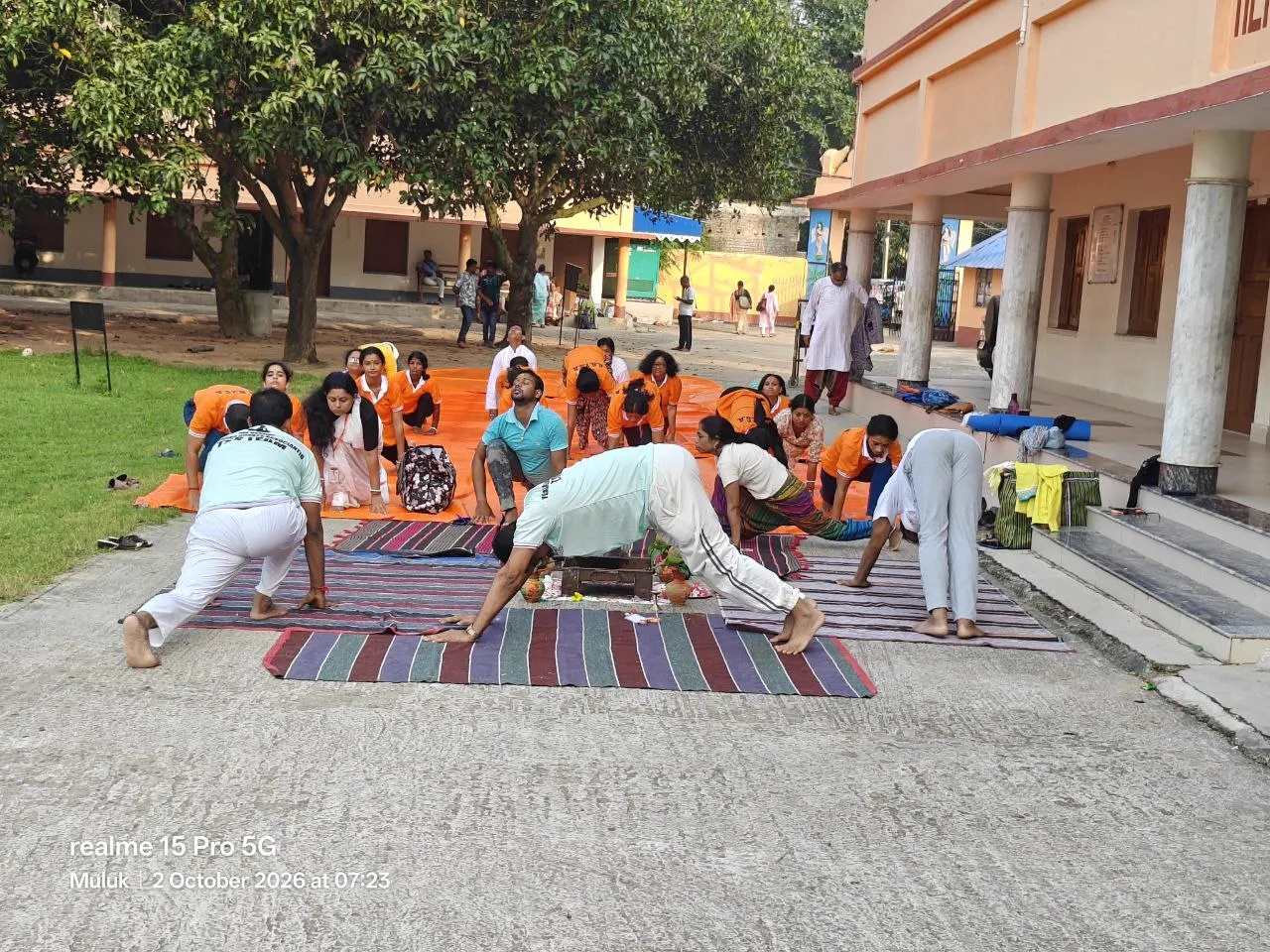
Morning practice on the mats beside the health centre at Muluk.
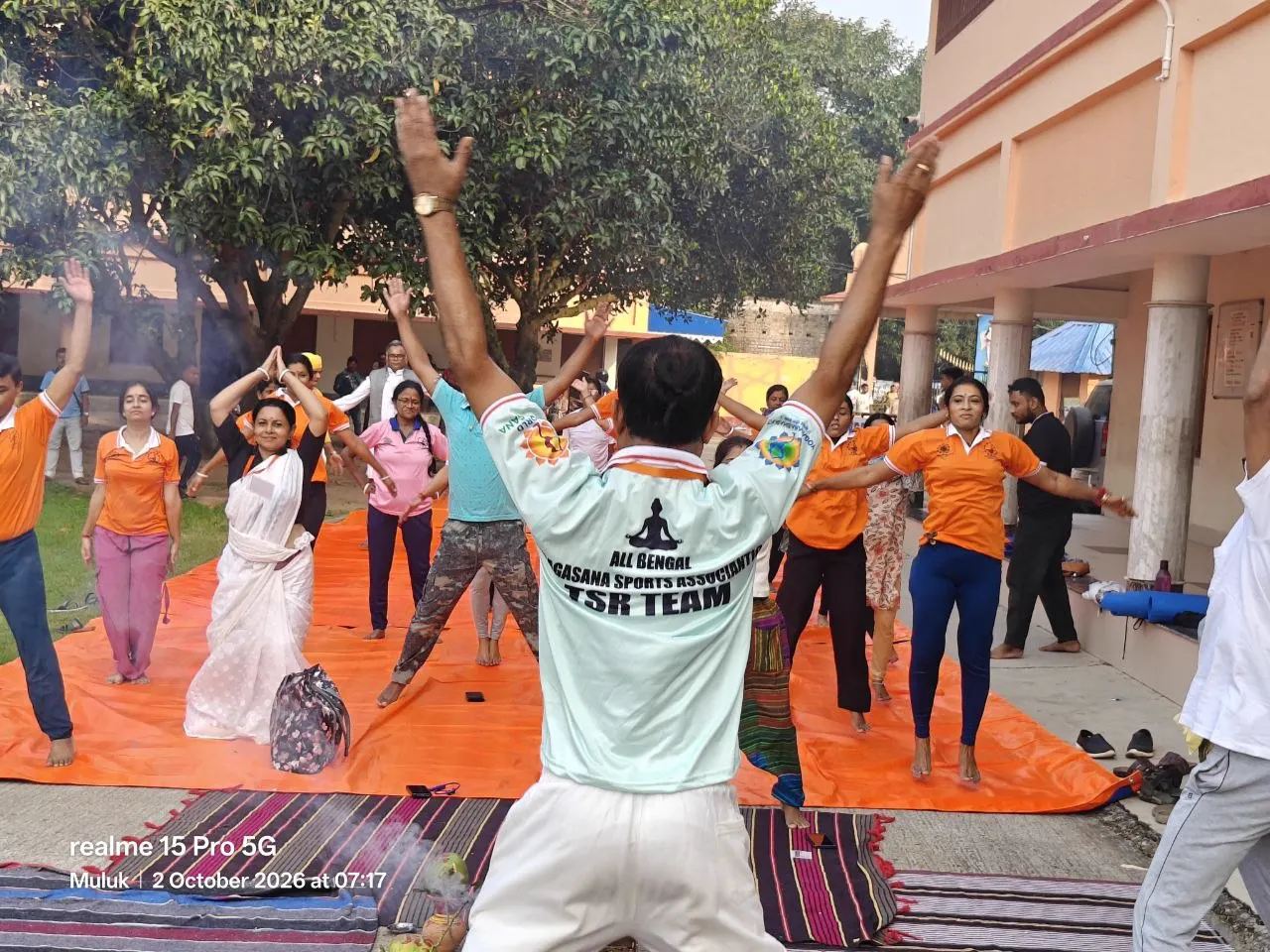
Arms raised, led by the All Bengal Yogasana Sports Association team.
Shyamal Ta described the mornings of this championship as beginning near sunrise, about five o’clock, with the national flag, then a Vedic yajna at which he said athletes, judges and officials were present, then practice, then the competition. That was his account of how a day at Muluk began. It is not a second name for the championship, and it is not the name of one particular fire.
03
The morning of 3 October
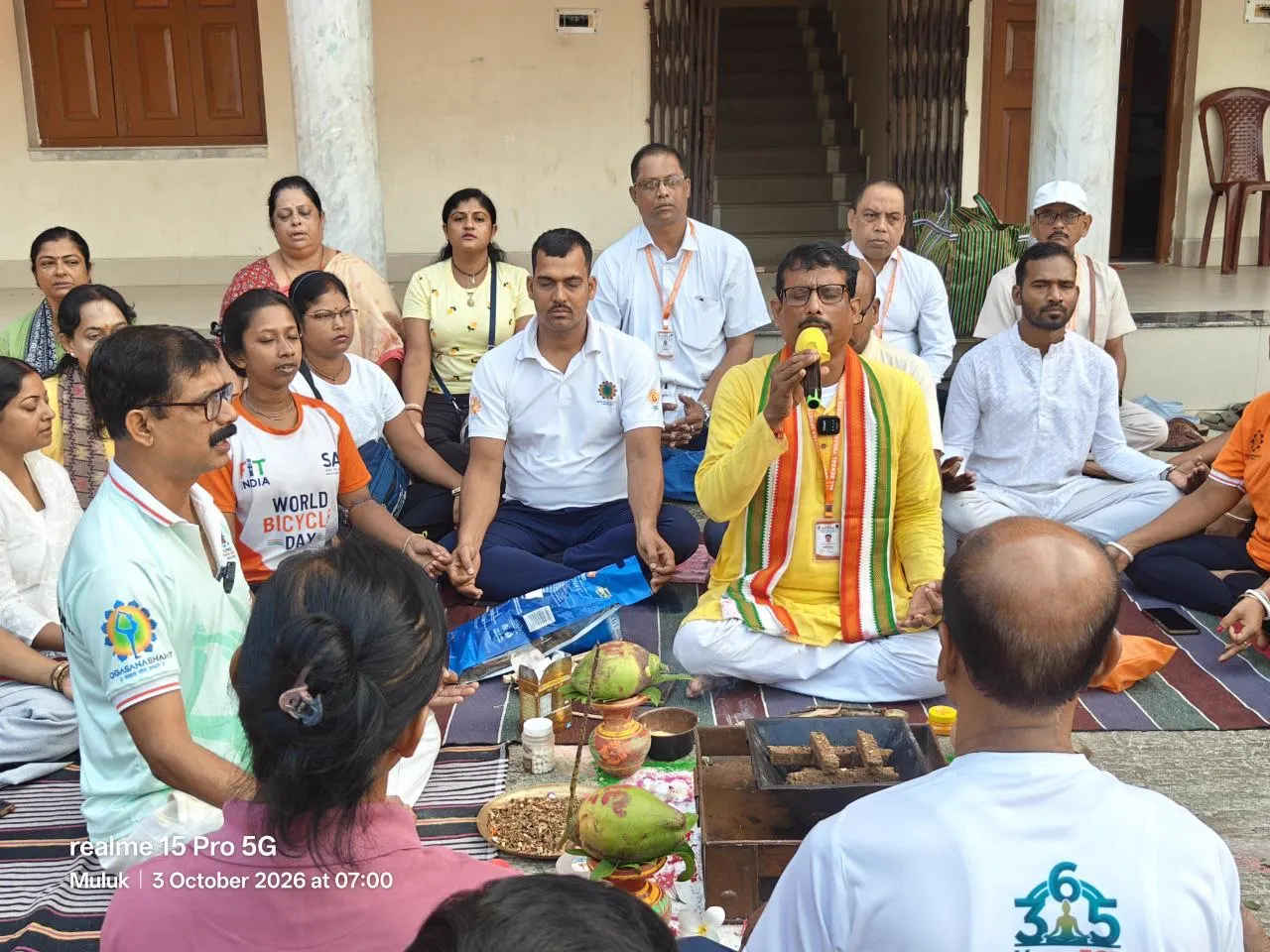
Shyamal Ta, State President of the All Bengal Yogasana Sports Association, addressing the courtyard gathering at Bharat Sevashram Sangha, Muluk, on the morning of 3 October.
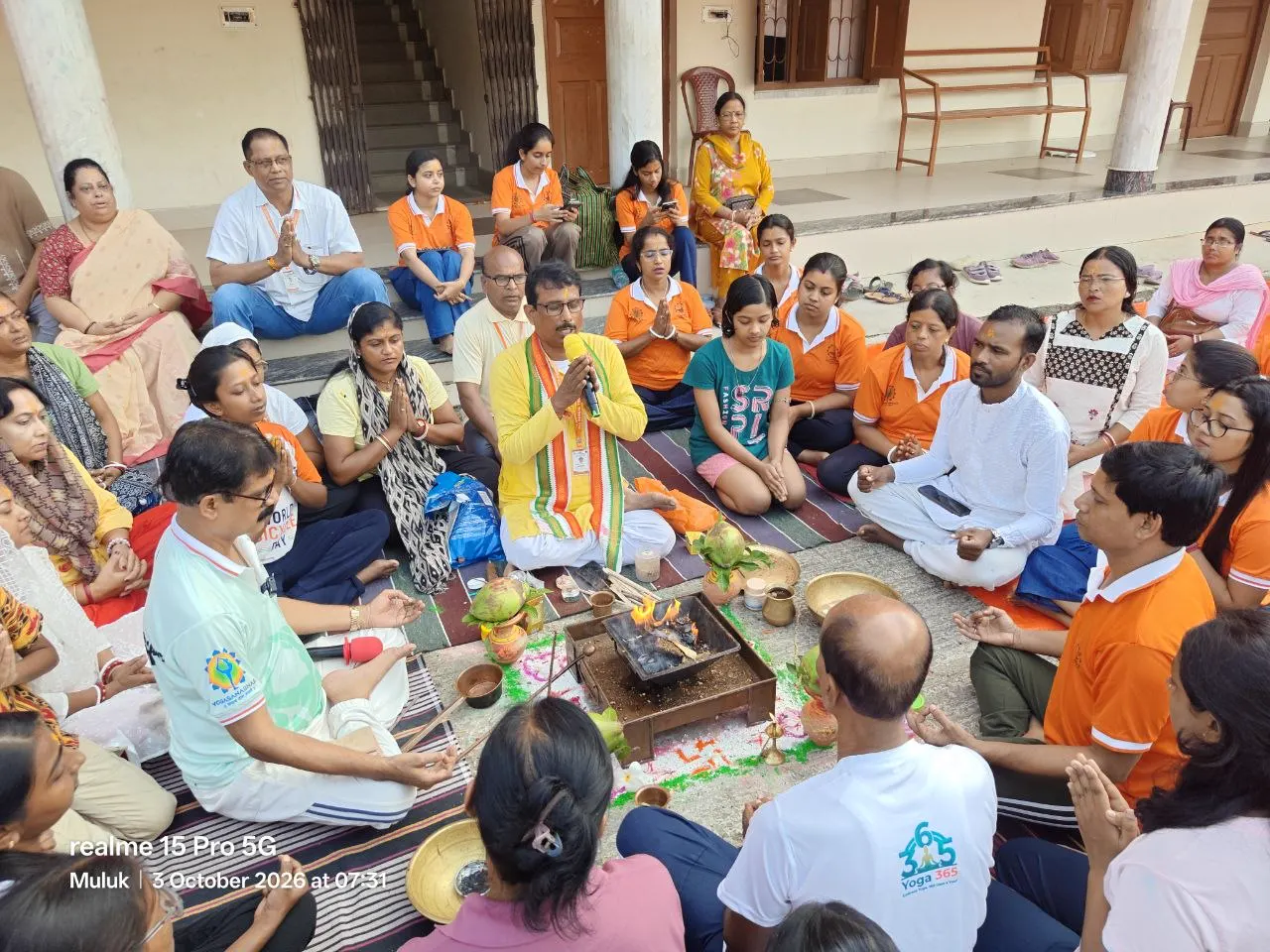
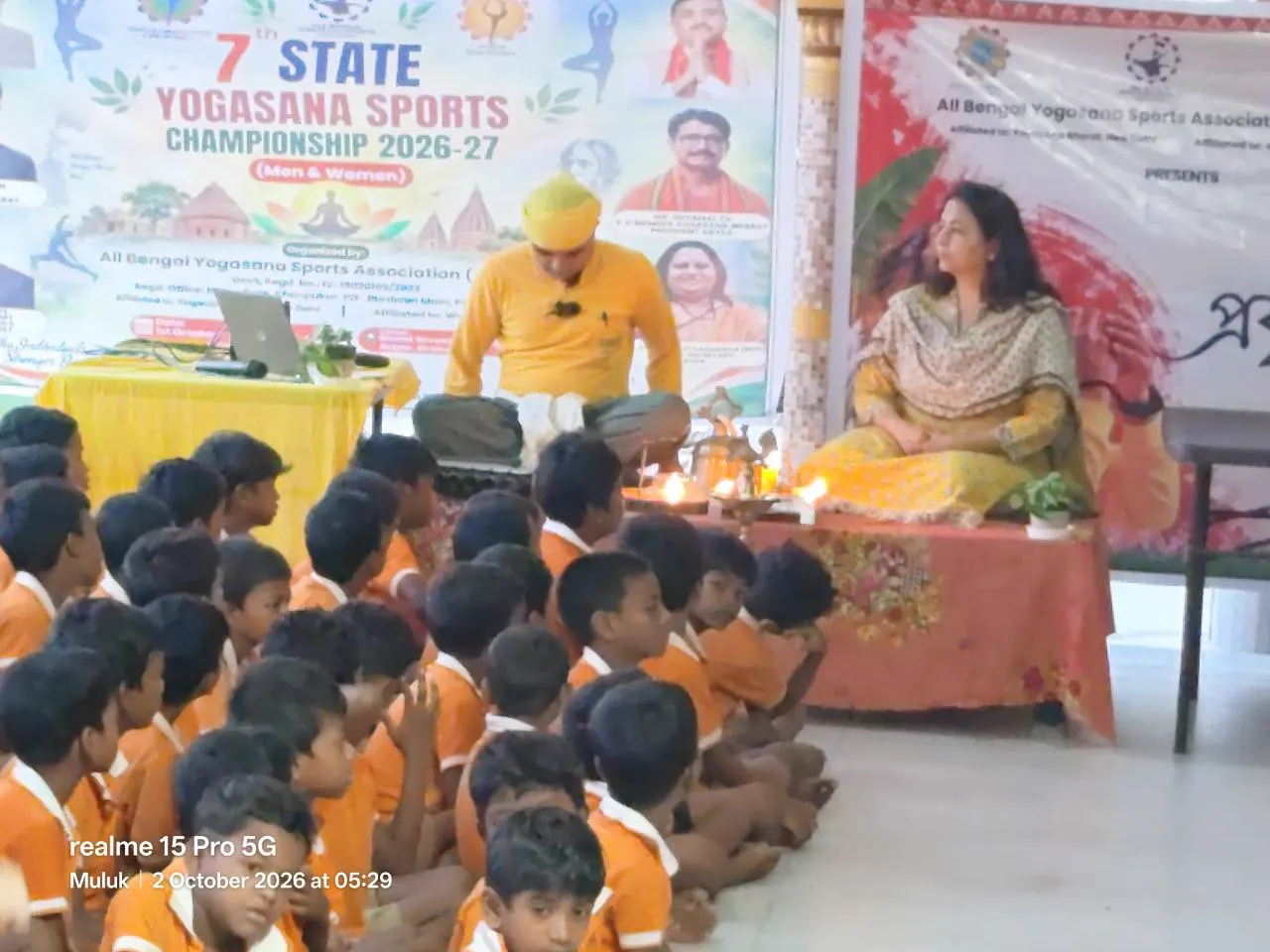
Shyamal Ta, State President of the All Bengal Yogasana Sports Association, beside the fire offering at Bharat Sevashram Sangha, Muluk, on the morning of 3 October.
The morning of 3 October stands apart from that description. In the courtyard at Bharat Sevashram Sangha, Muluk, Shyamal Ta addressed the gathering. He then sat beside the fire offering, microphone in hand, with athletes and officials around him.
The photographs of that morning show the address and the offering in the courtyard. They do not rename the rite.
04
Food, farming, and the young
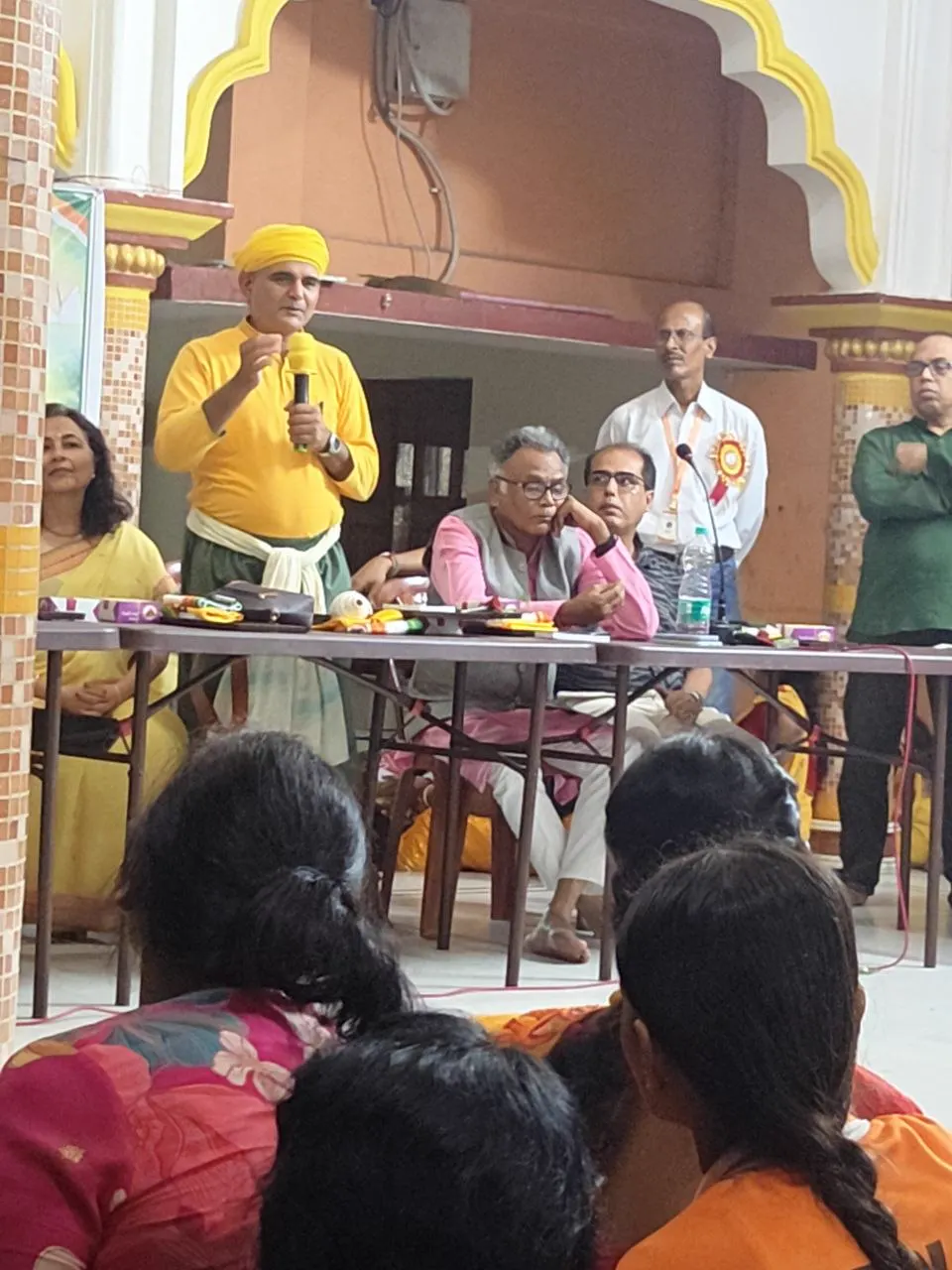
Sourabh J. Sarkar, Mahacharya, addressing the gathering.
The opening in the hall had already set Sourabh J. Sarkar beside the sport. The chair introduced him as Mahacharya and as State President of Bharatiya Krishak Samaj in West Bengal, said he was an IIT student, and argued that farming reaches its height only when science is applied to it. He called the Gangetic basin, from the lower country of Uttar Pradesh to the Bengal delta, the best land, and he recalled Vivekananda’s line that one who would be a king must first learn to be a subject. Bharatiya Krishak Samaj was a joint organiser. The introduction itself is told with the opening.
Amit Shil of Karmyog TV later sat with Shyamal Ta at the Sangha. He had come because he had been watching yoga programmes across West Bengal and beyond, and he remarked on the green, open grounds. Shyamal Ta described athletes coming through district competition from across the state. Shil then asked his own question. Karmyog, he said, had begun an effort he called Krishi Ratna League, to join cultivation with yoga so that this generation and the next might live with less illness and more strength. He asked how Shyamal Ta saw that joining.
Shyamal Ta called the thought timely. He said that had Shil been at the Sangha the day before, he would have heard Kartik Maharaj tell the athletes to rise at dawn, to practise daily, to learn the discipline of the Vedic yajna, and to eat food grown without poison. Shyamal Ta’s reading of that message was that the mat is not enough for a healthy body: food without poison has to reach the stomach, and that food comes from cultivation that refuses poison. He said the league and the association could stand together over the young and over farmers. That is his account of what was said, and of the joining.
Beside that account, Sourabh J. Sarkar addresses the gathering from the long table, and children sit before the banners. Neither frame is the interview with Shyamal Ta.
05
The opening invocation
The recording that carries the title Prakriti Jagran Yajna opens by invoking fifteen elements, outer and inner, as one field. It is the opening of this chapter, not a separate programme. The account opens on self-mastery: when body, breath, mind and consciousness are brought under one’s own hold, the restlessness of ordinary life can loosen, and service can become the purpose of a life. It welcomes the listener toward what it calls the good, the true and the beautiful.
The steps are walked in order. Earth is the ground under the feet. Water is what nourishes and moves. Fire is heat and change. Air is breath, the world’s and the person’s. Sky is the open space that holds the rest. Sun and moon follow: light, and the cooler balance of the night. Then the cosmos, and the living world, the web of creatures. Only then does the account turn inward: the body as the vessel, the breath as the life in it, the mind, consciousness as memory and awareness, the self, and at last the whole, in which no part is left outside. The teaching is that the part contains the whole, and the whole contains every part. Nature is not treated there as a store of material standing apart from the person who eats and practises.
The same account then asks auspiciousness for each step in turn, from the earth to the whole. It sets beside that chant the Vedic verse of fullness, that the full comes out of the full and the full remains, and the wish that all beings be happy. It speaks of work done without claiming the fruit, of a land of grain and flower, and of a strength that does not bargain for an easy path. That film closes on the national anthem. This is the opening of the Prakriti Jagran Yajna recording. It is not the name of the fire photographed on the morning of 3 October, and it is not a second title for the meet.
06
The recorded talk

Shyamal Ta, in the Vedic yajna recording.
A recording made around this championship keeps Shyamal Ta, and the speakers with him, on the Vedic yajna. It is a long discourse, not a caption for the courtyard photograph. They argue, they chant, they describe the morning of the meet, and they teach a way of eating, bathing and breathing. What follows is their account, in the order of the film. The listener who wants the voices themselves can open the recording.
07
An offering that does not choose
They call yajna the highest work because, in their telling, it is given without choosing who should receive it. A profession, they say, serves the person who pays. A yajna serves without that choice. Shyamal Ta illustrates the claim with a dry chili put into the fire: the room fills with the heat and the smell, and he says the fire multiplies what is offered many times over. He offers that picture as the logic of ghee and of the other things placed in the flame. The chili, and the multiplication, are his illustration in the film. They are not chemistry, and they are not medicine.
They cite the Vedic sentence that yajna is the best of works. They speak of the fire as the mouth through which an offering is received, and of yajna as a navel of the world. They place the rite in a tradition they say has not been broken, rather than as an invention of this championship. The same film returns to the morning he described elsewhere: the flag near sunrise, the yajna, practice, then the competition.
08
The prayers in the recording
The film is not only argument. It includes prayer and mantra. An opening song asks for the strength to bear sorrow, and not to be shaken from the path. The Gayatri is chanted, the prayer that divine light guide the intellect. Another prayer asks that what is harmful be removed and what is good be brought near. They describe the sipping of water and the touching of the body, dedicating speech, breath, sight, hearing, the arms and the thighs. The principal offering is accompanied by the Mahamrityunjaya mantra, and the rite is closed with the full offering and the peace chant. These are the words of the recording. They explain a dedication of work. They are not a second title for the championship, and they are not a prescription.
09
Meals, in their words
In the same discourse he speaks of what athletes at a championship were given to eat. He says the fried food and the meat of the market were kept off the table. He says the meals were sattvic, with ghee and fresh curd, so that digestion would hold, and he says that on that food not one of the hundreds fell ill in the stomach. That is his account of the kitchen. It is his explanation. It is not a medical study, and nothing on this page is advice for treating an illness.
He ties the meal back to the field. Practice on the mat, in this discourse, does not by itself feed a body. Food grown without poison has to reach the stomach, and that food, he says, comes from cultivation that refuses poison. The same joining is what Amit Shil asked him about, and what the opening had already set beside Sourabh J. Sarkar and the Gangetic plain.
10
A morning he taught
Apart from the timetable of the meet, he teaches a day he calls Vedic. A bath in cold water before sunrise, which he says raises what he calls the body’s electrical charge, and he gives a range in volts. Water drunk on waking, before the mouth is cleaned, which he says carries the night’s saliva into the stomach as a digestive medicine, and he gives a weight in grams. Two or three meals: a full one after practice, and a light one later. The volts and the grams are the figures he speaks in the film. They are his explanation of a practice. They are not established here as physiology, and they are not medical advice.
11
Breath, attention, and a life given
Toward the end he describes bhastrika, a forceful breath held with a posture, and he offers a ratio of oxygen he says the breath takes in. He speaks of haemoglobin and of women’s health, and he tells the physical capacity of the Pandavas as a story of that practice. He then sets conditions for meditation: a seat, a change in the breath, and a ladder he names from courage toward samadhi. He maps eight centres in the body, and he quotes a line about eight centres and nine gates. He cites a Chanakya line on the end of poverty, and he says a person without money can still give time and intelligence. He tells of a teacher, Ashish Dar, as a life he says was turned by that giving.
This is his yogic teaching in the recording. The public record of the championship remains the sport on the mat, the gathering in the hall and the courtyard, and this discourse, attributed to the people who speak it. The film is there for anyone who wants the argument in their voices.
12
Mahacharya and Gunomata
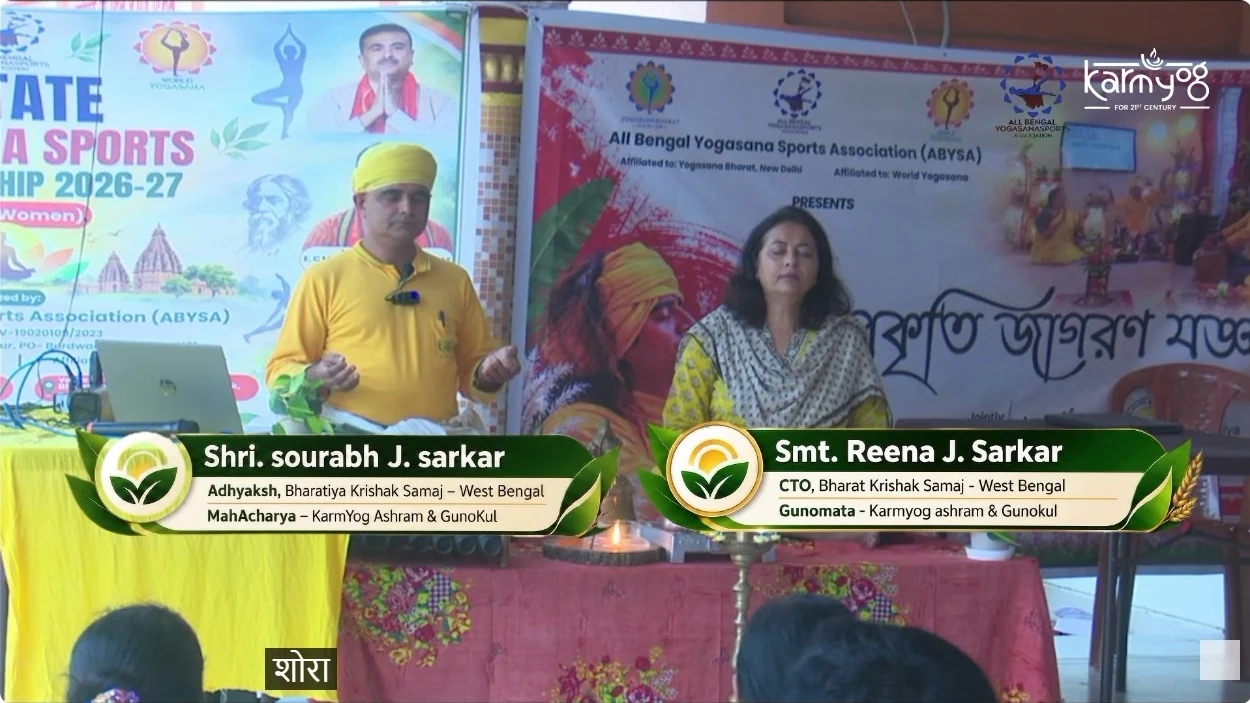
Mahacharya Sourabh J. Sarkar and Gunomata Reena J. Sarkar, in the Prakriti Jagran Yajna recording.
A separate recording from the championship carries the public title প্রকৃতি জাগরণ যজ্ঞ. On its lower third, Sourabh J. Sarkar is named Adhyaksh of Bharatiya Krishak Samaj in West Bengal, and Mahacharya of Karmyog Ashram and GunoKul. Reena J. Sarkar is named CTO of Bharat Krishak Samaj in West Bengal, and Gunomata of Karmyog Ashram and GunoKul. He stands in yellow, microphone in hand. She sits beside him. That is the sitting in the film.
The chair’s introduction of Sourabh J. Sarkar, at the opening, is a different moment: the chair’s words, told with the four days. Rina-ji, who spoke then about practice continuing, is not named on this lower third. The courtyard fire of 3 October is a third thing, photographed in the morning, and it is not given this film’s title. The Vedic discourse with Shyamal Ta remains the other recording.
13
Inside the championship
Judging, certificates, and medals remained the sporting close. Prakriti Jagran Yajna was the company the meet kept beside the sport: an ashram, a farmers’ organisation, and a sporting body, on the same grounds, while athletes performed. From the courtyard the day moved into the hall. The courtyard fire of 3 October stays a photograph of that morning. It is not given this chapter’s title.